Introduction
The Union Public Service Commission (UPSC) Civil Services Examination (CSE) stands as one of India’s most prestigious and challenging gateways to public service, attracting over a million aspirants annually for roughly 900 positions. Traditionally, preparation has relied on rote learning, coaching institutes, and static resources like books and newspapers. However, with rapid advancements in technology and shifting educational paradigms, the landscape is evolving dramatically. Emerging trends such as personalized learning and adaptive assessments, coupled with technologies like Artificial Intelligence (AI), Machine Learning (ML), Virtual Reality (VR), and Augmented Reality (AR), are poised to redefine how aspirants prepare for this rigorous exam.
In 2025, as India pushes its digital revolution—exporting innovations like UPI while grappling with domestic challenges in exam integrity—the integration of tech in UPSC prep is no longer optional but essential. AI tools are democratizing access to high-quality resources, offering tailored study plans and real-time feedback. Yet, only about 40% of aspirants have adopted these, highlighting a gap between potential and practice. This note explores the historical context, current trends, technological integrations, challenges, and future outlook, emphasizing how these elements will shape a more efficient, inclusive, and effective preparation ecosystem. By leveraging these advancements, aspirants can transition from passive learners to proactive strategists, ultimately enhancing their chances in this hyper-competitive arena.
Historical Evolution of UPSC Preparation
UPSC preparation has undergone significant transformations since the exam’s inception in 1922. Initially, it mirrored the British Indian Civil Service model, focusing on colonial administrative skills through essay-based assessments. Post-independence, the syllabus expanded to include Indian history, polity, and current affairs, aligning with nation-building goals. In the 1970s-80s, coaching institutes like those in Delhi’s Mukherjee Nagar emerged as hubs, emphasizing structured classroom teaching and printed materials.
The 1990s marked the digital shift with the internet’s advent, introducing online forums and e-books. By the 2000s, platforms like Vision IAS and Mrunal.org provided free resources, reducing dependency on physical coaching. The 2010s saw mobile apps and YouTube channels democratize access; for instance, Unacademy and BYJU’s offered video lectures, reaching remote aspirants. However, challenges like information overload persisted.
The COVID-19 pandemic accelerated online learning, with live classes and virtual mocks becoming standard. Today, in 2025, AI-driven tools like PadhAI and Saval AI are integrating adaptive learning, analyzing performance to customize plans. This evolution reflects broader edtech growth in India, valued at $2.8 billion in 2023, projected to reach $10 billion by 2027.
From rote memorization to interactive simulations, the journey underscores technology’s role in making preparation more accessible. Yet, historical inequities—such as urban-rural divides—remain, which emerging tech aims to bridge.
Emerging Trends in UPSC Preparation
Several trends are reshaping UPSC preparation in 2025, driven by technological and societal shifts. Personalized learning tops the list, where AI algorithms create bespoke study paths based on individual strengths and weaknesses. Platforms like SuperKalam and Drishti IAS apps use data analytics to adjust difficulty levels, ensuring efficient coverage of vast syllabi.
Adaptive assessments simulate exam conditions, providing real-time feedback and predictive scoring. For instance, AI-based mocks evaluate not just answers but reasoning patterns, mirroring UPSC’s analytical focus. Gamification introduces elements like quizzes, badges, and leaderboards on apps such as Quizlet, boosting engagement.
Collaborative learning via virtual communities on Telegram and Discord fosters peer discussions, while micro-learning—short, focused modules—suits busy aspirants. Sustainability trends emphasize mental health tools, with apps integrating mindfulness for burnout prevention.
Current affairs integration has evolved; AI curates daily digests from sources like PIB and The Hindu, linking them to syllabus topics. Hybrid models blend online and offline, as seen in post-pandemic coaching.
These trends address UPSC’s dynamic nature, where prelims weightage shifts toward tech topics like AI and quantum computing. By 2025, 95% of aspirants recognize AI’s value, yet adoption lags, indicating a transitional phase.
Also read : How to Use YouTube & Online Resources for UPSC Preparation: A Complete Guide
Role of Technologies in UPSC Preparation
Technology is the cornerstone of future UPSC prep, with AI and ML leading the charge. AI tools like ChatGPT and Grok assist in generating mains answers, essays, and MCQs, while verifying facts to avoid hallucinations. PadhAI, for example, scored over 170 in prelims mocks, showcasing potential for adaptive testing. ML analyzes past papers to predict trends, focusing on high-yield areas like biotech and space tech.
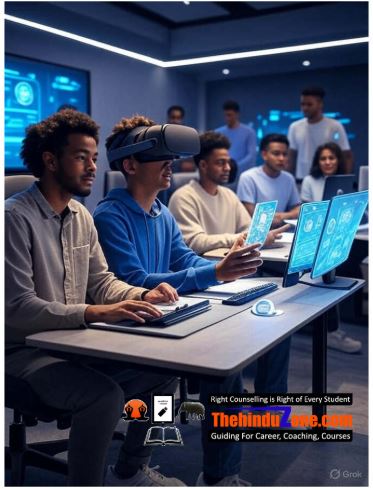
VR/AR immerses aspirants in historical events or geographical simulations, enhancing retention for GS papers. Blockchain ensures secure credential verification, addressing exam fraud amid recent controversies.
Online platforms like StudyIQ and UPSC Guide offer comprehensive courses with live doubts sessions and analytics. Apps such as Ensemble Courses and Ignite IAS provide mobile-first tools for time management and current affairs. Big data aggregates aspirant performance for benchmarking.
UPSC itself is adopting tech: Aadhaar-fingerprint and AI-CCTV for integrity. Emerging tech like quantum computing and IoT are syllabus staples, requiring prep tools to evolve.
Verification layers, as in Learnrite’s partnership with Mira Network, reduce AI errors from 28% to 4.4%, scaling quality content. These technologies not only streamline prep but foster deeper understanding, preparing aspirants for tech-savvy governance roles.
Challenges and Ethical Considerations
Despite promise, challenges abound. Over-reliance on AI risks diminishing critical thinking; unverified content can mislead, as warned by experts. Data privacy concerns arise with platforms collecting user info for personalization.
Access inequality persists; while AI democratizes prep, tier-II/III city aspirants lag in adoption due to infrastructure gaps. High costs of premium apps exclude many, perpetuating urban bias.
Ethical issues include AI biases in content generation and the potential for deepfakes in learning materials. UPSC’s tech integration, like facial recognition, raises surveillance fears.
Mental health strains from constant analytics and competition need addressing through balanced tools. Solutions involve ethical AI guidelines and inclusive policies.
Case Studies and Real-World Applications
Real-world examples illustrate impact. PadhAI’s AI tutor curates news and quizzes, reducing study time by 30%. Saval AI’s semantic tools provide UPSC-relevant insights, like historical analyses.
Impulse CS’s hybrid model uses AI for mains evaluation, simulating UPSC markers. Learnrite scaled questions 30x via verification, personalizing for 1.5M aspirants.
These cases show tech’s transformative power, from error reduction to scalability.
also read :Women in Indian Politics: Progress & Challenges
Future Predictions
By 2030, UPSC prep will be fully AI-integrated, with neuromorphic computing enabling hyper-personalized simulations. Metaverse-based coaching will allow virtual interviews, and blockchain will verify prep credentials.
Trends like generative AI for essay drafting and AR for fieldwork training will dominate. UPSC may adopt adaptive exams, phasing out traditional formats.
Equity will improve with government subsidies for tech access, but ethical oversight will be crucial.
Also read : What is a salary of an IAS officer
Impact on Coaching Institutes and Aspirants
Coaching revenues may decline as AI offers free alternatives, forcing adaptation. Aspirants benefit from flexibility, but must develop tech literacy.
Institutes like Sleepy Classes are already integrating AI for efficiency.
Strategies for Aspirants in the Tech Era
Aspirants should blend tech with traditional methods: use AI for prelims practice, VR for geography, and apps for time management. Verify AI outputs and focus on ethics.
Build digital skills early for future governance roles.
Global Comparisons and Lessons
Globally, exams like GRE use adaptive testing; India can learn from Rwanda’s edtech for inclusivity. UPSC’s tech adoption mirrors SAT’s AI grading.
Lessons: Prioritize equity and human-AI synergy.
Policy Recommendations
Government should mandate AI ethics in edtech, subsidize tools for rural aspirants, and integrate tech in UPSC training. Collaborate with startups like Puch AI for innovative solutions.
Conclusion
The future of UPSC preparation lies in harnessing emerging trends and technologies for inclusive, efficient learning. While challenges exist, the potential for transformation is immense, promising a new era of empowered civil servants.
Also read : best mentorship programme for UPSC 2026