Introduction
The Union Public Service Commission (UPSC) Civil Services Examination (CSE) is one of the most competitive and challenging exams in India. Aspirants often debate whether UPSC coaching is necessary or if self-study is sufficient. While some candidates clear the exam without coaching, others rely heavily on structured guidance.
This note explores:
- The role of UPSC coaching in preparation.
- Pros and cons of joining a coaching institute.
- How to choose the right coaching center.
- Alternatives to traditional coaching.
- Success stories of candidates who used (or didn’t use) coaching.
By the end, aspirants will have a clear understanding of whether coaching is right for them and how to make an informed decision.
1. The Role of UPSC Coaching in Preparation
UPSC coaching provides structured guidance, study materials, and mentorship to help aspirants navigate the vast syllabus efficiently. However, its necessity depends on individual learning styles, background, and preparation strategy.
Key Benefits of UPSC Coaching:
✔ Structured Syllabus Coverage – Coaching institutes break down the syllabus into manageable modules, ensuring no topic is missed.
✔ Expert Guidance – Experienced faculty provide insights into exam trends, answer-writing techniques, and shortcuts.
✔ Peer Learning & Competition – Studying with fellow aspirants fosters a competitive environment, improving motivation.
✔ Test Series & Mock Exams – Regular assessments help in self-evaluation and time management.
✔ Access to Study Materials – Notes, books, and online resources save time in gathering information.
Limitations of UPSC Coaching:
✖ Expensive – Quality coaching can cost ₹1.5–3 lakhs, which may not be feasible for everyone.
✖ One-Size-Fits-All Approach – Some institutes follow a rigid curriculum, which may not suit all learners.
✖ Over-Reliance on Coaching – Some students depend too much on coaching and neglect self-study.
✖ Time-Consuming – Attending classes may leave less time for self-revision.
2. Pros and Cons of Joining UPSC Coaching
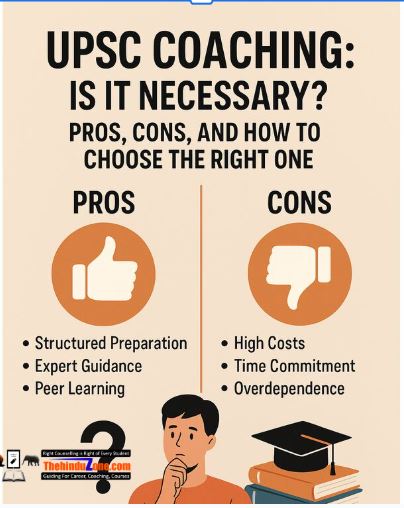
Pros of UPSC Coaching
- Systematic Study Plan – Helps in covering the syllabus efficiently.
- Expert Mentorship – Faculty with years of experience guide students on exam strategies.
- Access to Quality Resources – Notes, test series, and recommended books save time.
- Motivation & Discipline – Regular classes keep aspirants on track.
- Networking with Peers – Discussions with fellow aspirants enhance learning.
Cons of UPSC Coaching
- High Cost – Premium coaching institutes charge hefty fees.
- Not Always Necessary – Many toppers clear UPSC without coaching.
- Risk of Misinformation – Some institutes teach outdated or irrelevant content.
- Time-Consuming – Commuting to classes may reduce self-study time.
- Overdependence on Coaching – Some students stop thinking independently.
3. How to Choose the Right UPSC Coaching Institute
Factors to Consider Before Joining Coaching
- Reputation & Success Rate – Check past toppers and selection rates.
- Faculty Quality – Experienced teachers with UPSC expertise matter more than brand names.
- Study Material & Notes – Ensure the institute provides well-researched notes.
- Test Series & Feedback – Regular mock tests with detailed analysis are crucial.
- Location & Batch Timings – Choose a convenient location to avoid time wastage.
- Cost & Affordability – Compare fees and value for money.
- Online vs. Offline – Decide between physical classes or online courses.
Top UPSC Coaching Institutes in India (2024)
| Institute | Specialty | Fees (Approx.) | Locations |
|---|---|---|---|
| plutus IAS | Best for Prelims & Mains | ₹1.0–2.5L | Delhi, Online |
| Yojna IAS | Best for Prelims & Mains | ₹1.0–1.8L | Delhi, Online |
| Drishti IAS | Good for Beginners | ₹1.2–2L | Delhi, Online |
| Vision IAS | Best for Test Series | ₹1.5–2.5L | Delhi, Online |
| Alochana IAS | Affordable & Effective | ₹80K–1.5L | Delhi, Online |
| Shubra ranjan | Best for Optional Subjects | ₹1–1.8L | Delhi, Online |
How to Evaluate a Coaching Institute?
✔ Attend Demo Lectures – Gauge teaching quality before enrolling.
✔ Check Student Reviews – Look for genuine feedback on Quora, Reddit, and YouTube.
✔ Compare Syllabus Coverage – Ensure all subjects are covered in depth.
✔ Ask About Doubt-Clearing Sessions – Good institutes provide extra support.
✔ Check for Online Options – If commuting is difficult, opt for online classes.
4. Alternatives to Traditional UPSC Coaching
Self-Study with Online Resources
Many aspirants clear UPSC without coaching by using:
- YouTube Channels ( Plutus ias ,StudyIQ , etc.)
- Telegram Channels (UPSC Daily News, IASbaba, etc.)
- Online Test Series (Insights, Gradeup, etc.)
- Books & NCERTs (Laxmikanth, M. Puri, Spectrum, etc.)
Mentorship & Guidance Programs
- Free Mentorship by Toppers (Many toppers offer free guidance on YouTube/Telegram).
- Online Courses (Unacademy, BYJU’S, etc.) at a fraction of offline coaching costs.
Study Groups & Peer Learning
- Joining WhatsApp/Telegram study groups for discussions.
- Forming study circles with friends for mutual support.
5. Success Stories: Coaching vs. Self-Study
Toppers Who Used Coaching
- Aditi varshney (AIR 57,2022)– Attended Plutus IAS.
- Suryabhan Achchhelal (AIR 27, 2022)– Took coaching from Plutus IAS.
- Anudeep Durishetty (AIR 1, 2017) – Used Vision IAS for test series.
Toppers Who Cleared Without Coaching
- Ankita Jain (AIR 1, 2020) – Self-study with online resources.
- Shubham Kumar (AIR 1, 2021) – Relied on NCERTs and YouTube.
- Aditya Srivastava (AIR 1, 2022) – Used free online materials.
6. Conclusion: Should You Join UPSC Coaching?
- Join coaching if:
- You need structured guidance.
- You lack self-discipline.
- You want expert mentorship.
- Avoid coaching if:
- You can self-study effectively.
- You have limited budget.
- You prefer flexibility in learning.
Final Tips for Aspirants
✅ If joining coaching: Choose wisely, stay disciplined, and supplement with self-study.
✅ If self-studying: Use online resources, join test series, and stay consistent.
✅ Regardless of choice: Focus on answer writing, revision, and current affairs.
Read also: best IAS coaching in Delhi.
Related : best teachers for UPSC exam.
best economics services coaching.
Frequently Asked Questions
Coaching is not strictly necessary for UPSC CSE, but it provides structure, mentorship, and peer competition that self-study cannot replicate. About 30–40% of UPSC toppers have cleared without formal coaching. However, for beginners with no knowledge of the exam pattern, a foundation course or test series from a reputed institute can significantly reduce the learning curve.
Yes, self-study is sufficient if you have strong self-discipline, access to quality study material, and a reliable test series. Key resources for self-study include NCERT textbooks, standard reference books (Laxmikanth, Bipan Chandra, Shankar IAS Environment), The Hindu newspaper, and mocks from Insights or ForumIAS. Many toppers — including rank-1 holders — have cleared through self-study.
Pros of joining UPSC coaching: structured curriculum, expert faculty, access to study materials, peer motivation, doubt-clearing sessions, and test series. Cons: high cost (₹1–2 lakh for full program), risk of developing dependency on notes, classroom time cuts into self-study hours, and quality varies vastly between institutes. The best approach is selective coaching (only for weak subjects) combined with strong self-study.
UPSC coaching fees in 2026 range widely: full integrated programs at top institutes (Vajiram, Shankar IAS, Vision IAS) cost ₹1.5–2.5 lakh. Online programs from Unacademy, BYJU’s IAS, or PWOnlyIAS range from ₹50,000–1.5 lakh. Subject-specific or optional coaching costs ₹20,000–60,000. Test series subscriptions range from ₹3,000–15,000 annually. Many free resources are also available on YouTube.
When choosing a UPSC coaching institute: check the recent selection list and ranks achieved by students, verify faculty credentials and consistency (institutes often change faculty), attend a demo class before enrolling, compare study material quality, assess batch size (smaller batches allow more interaction), and check the test series quality. Location and online availability are secondary to faculty quality and past results.