Best Hosting Services for Indian Websites & Apps in 2026-27
Choosing the right hosting service is one of the most important decisions when building a website or an app. Performance, uptime, security, scalability — all depend heavily on your hosting. For Indian websites, or for apps with users in India, additional factors like latency, local customer support, data centre locations, regulatory compliance, and pricing (in INR with GST) matter more than ever.
This article walks you through what to look for in a good host for Indian websites/apps, and then compares some of the best hosting services (Indian & global) in 2025. We also consider “app-hosting” or backend options (API servers, mobile backend, etc.). By the end, you’ll have a clear idea of which providers might suit your needs best.
How to become Machine learning engineer
What to Consider When Picking a Hosting for Indian Websites / Apps
- Data centre location & latency: Having servers in India or nearby (Singapore, Mumbai, Chennai, Bengaluru) helps reduce latency. For apps, lower ping improves user experience.
- Uptime & SLAs: Ideally 99.9%+ uptime guarantees. Downtime affects trust, revenue, SEO.
- Scalability: Ability to scale vertically (better CPU, RAM, etc.) or horizontally (add more servers). Cloud hosting or managed VPS makes this easier.
- Security: SSL, firewall / DDoS protection, secure backups, isolation between accounts, etc.
- Support: Local (Indian) support in local time, preferably via chat, ticket & phone. Indian support staff can understand local infrastructure issues better.
- Pricing & billing: Transparent pricing with INR payment option. Watch renewals (some hosts hike prices). Also consider cost of bandwidth, storage, database usage.
- Technology stack support: If your app uses Node.js, Python, Go, Ruby, Java, etc., ensure support. Also support for database choices (MySQL, PostgreSQL, MongoDB etc.), presence of CDNs, caching, etc.
- Managed vs Unmanaged: Managed hosting (where the host handles server setup, updates, security) costs more but saves you time. For apps especially, managed services reduce DevOps overhead.
- Compliance & data sovereignty: Especially if you’re handling user data, check if the hosting provider helps with compliance (India’s rules, privacy, etc.).
Types of Hosting Useful for Apps & Websites
Before choosing a provider, understand different types of hosting:
- Shared Hosting: Cheapest; many websites share resources. Good for small websites/blogs, not for heavy apps.
- VPS (Virtual Private Server): More control & resources; ideal for growing apps or websites with steady traffic.
- Managed VPS / Managed Hosting: Same as VPS but host manages setup, updates, etc.
- Cloud Hosting / Cloud Servers: Highly scalable, often pay-as-you-go. E.g. AWS, Google Cloud, DigitalOcean, etc.
- PaaS / Backend as a Service (BaaS): For apps where backend + APIs are needed. They handle much of infrastructure (scaling, maintenance). Examples: Firebase, AWS Amplify, etc.
- Dedicated Servers: Entire server for you. Costly but gives full control. Used by large apps/sites.
Best Hosting Services for Indian Websites & Apps
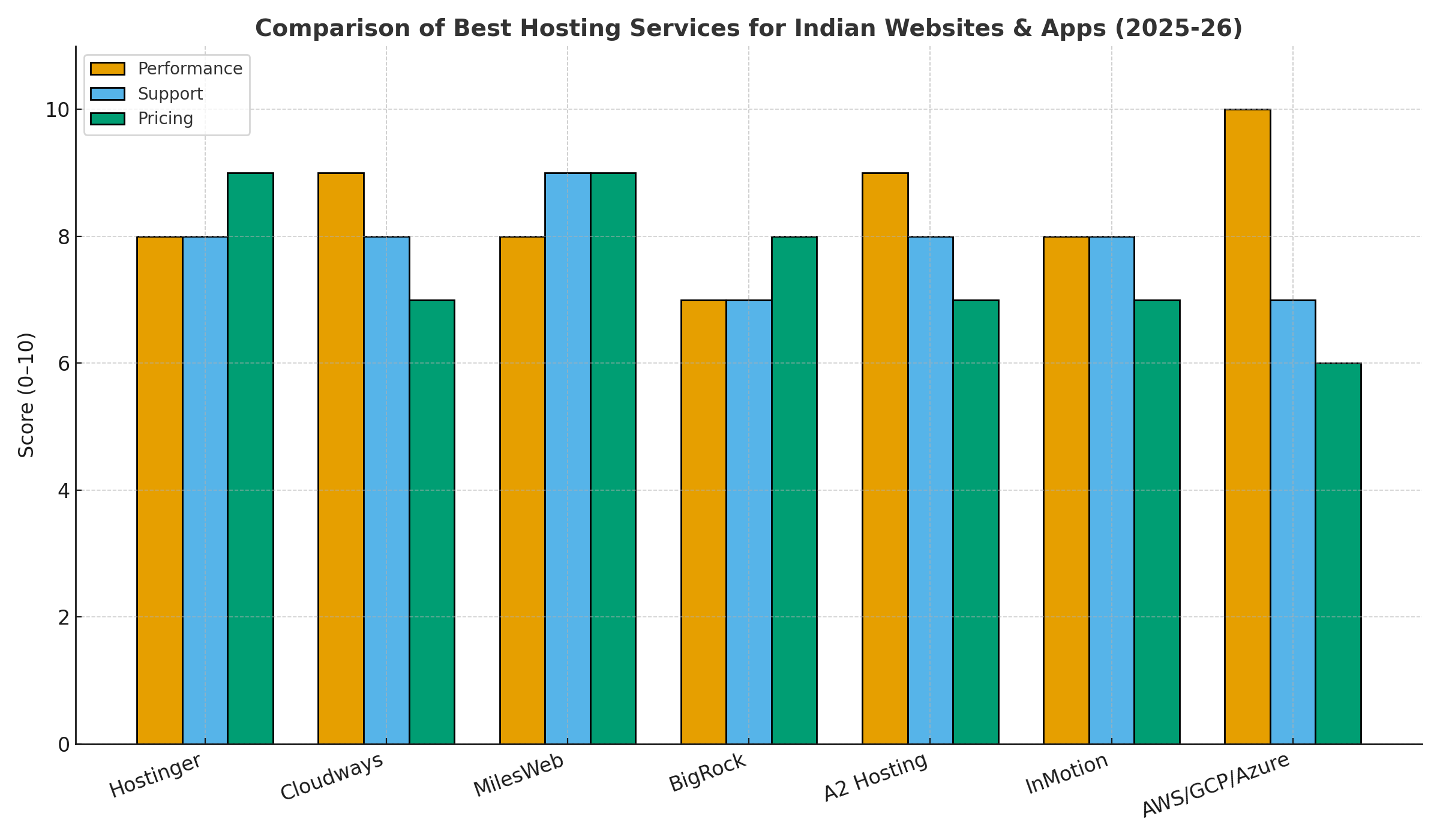
Here are some of the best hosting providers in India / serving India well, along with their pros & cons. Depending on your needs (static site, WordPress blog, Node.js app, mobile backend) different providers may be better.
| Provider | Strengths | Ideal Use Case | Considerations |
|---|---|---|---|
| Hostinger | Affordable shared & cloud hosting; good performance; user friendly dashboard. :contentReference[oaicite:0]{index=0} | Small/medium websites, blogs, WordPress, early stage apps with limited backend needs. | Shared plans have limits; not always ideal for high concurrency or custom server setups. |
| Cloudways | Managed cloud hosting; can use AWS / DigitalOcean / etc.; good caching, API support; strong performance. :contentReference[oaicite:1]{index=1} | Growing apps, APIs, backend services; when you want scalability without managing servers fully. | Cost is higher; billing can get unpredictable with resource usage; might need DevOps knowledge. |
| MilesWeb (India) | Local presence, good performance in India; NVMe storage, good support; affordable for Indian budgets. :contentReference[oaicite:2]{index=2} | India-targeted websites/apps, e-commerce stores, WordPress + WooCommerce, small-medium traffic apps. | If traffic scales heavily, may need to move to bigger cloud servers; certain advanced stacks may require more configuration. |
| BigRock | Popular Indian provider; known for domain registration + shared/VPS hosting; lots of local users. :contentReference[oaicite:3]{index=3} | Basic websites, businesses wanting reliable Indian support and domain/hosting bundle. | Performance isn’t as strong as premium cloud providers; sometimes support slower on technical & scaling issues. |
| A2 Hosting | Strong global performance; optimized servers; good for apps with international users; various server locations. :contentReference[oaicite:4]{index=4} | Hybrid apps (India + abroad users), web apps needing performance, dev-friendly stacks. | Higher pricing; support sometimes less India-centric; may need to choose data centres wisely. |
| InMotion Hosting | Reliable customer service; good uptime; variety of plans. :contentReference[oaicite:5]{index=5} | Small-to-medium apps, business websites, WordPress + custom PHP apps. | International servers may be far; latency for Indian user base may be slightly higher unless local server used. |
| Global Cloud Providers (AWS, Google Cloud, Azure, DigitalOcean, Linode) | Best scalability, global server locations, pay for what you use, strong services (CDN, load balancing, DB etc.). | High growth apps; apps expecting strong traffic; microservices; mobile backends; where performance, resilience, uptime matter. | More complex to manage; cost can be high; need DevOps or hiring someone; billing in USD may fluctuate. |
Which Hosting for Which Kind of App / Website?
Here are recommendations depending on typical use cases:
- Simple brochure / blog / WordPress site for India-audience: Go for a budget shared host from an Indian provider like MilesWeb or Hostinger with server in India.
- E-commerce or WooCommerce site: Need better performance, SSL, good support — Managed hosting or VPS / Cloud. Maybe Cloudways or AWS Lightsail.
- Mobile or Web Apps (APIs, microservices): Use cloud servers or PaaS/BaaS (AWS, Google Cloud, Firebase, or DigitalOcean) with auto-scaling if possible.
- Hybrid / international traffic: Choose a provider with multiple data centres (India + Asia + US or Europe), CDN support, good global reach.
- Startups / MVPs: Use scalable cloud hosting with pay-as-you-go (e.g. AWS, DigitalOcean, Cloudways), so you only pay for what you need initially.
Tips to Optimize Hosting for Indian Apps / Websites
Even after picking good hosting, these tweaks make a big difference:
- Use a CDN (Content Delivery Network) to reduce latency – local edge servers help for Indian users.
- Enable HTTP/2 or HTTP/3, caching (Redis / Varnish) where possible.
- Choose SSD or NVMe storage; avoid slow HDD based hosting.
- Monitor performance: Use tools like GTmetrix, WebPageTest, or Pingdom for page speed and server response time.
- Regular backups & disaster recovery plans.
- Security: Use SSL, web application firewall (WAF), keep software & dependencies updated.
- Scalability: Ensure you can upgrade CPU / RAM easily or add load balancing.
Conclusion
For Indian websites and apps, the “best” hosting depends heavily on your current traffic, technical stack, and user base. If you’re just starting out, choose a local provider with solid support and server location in