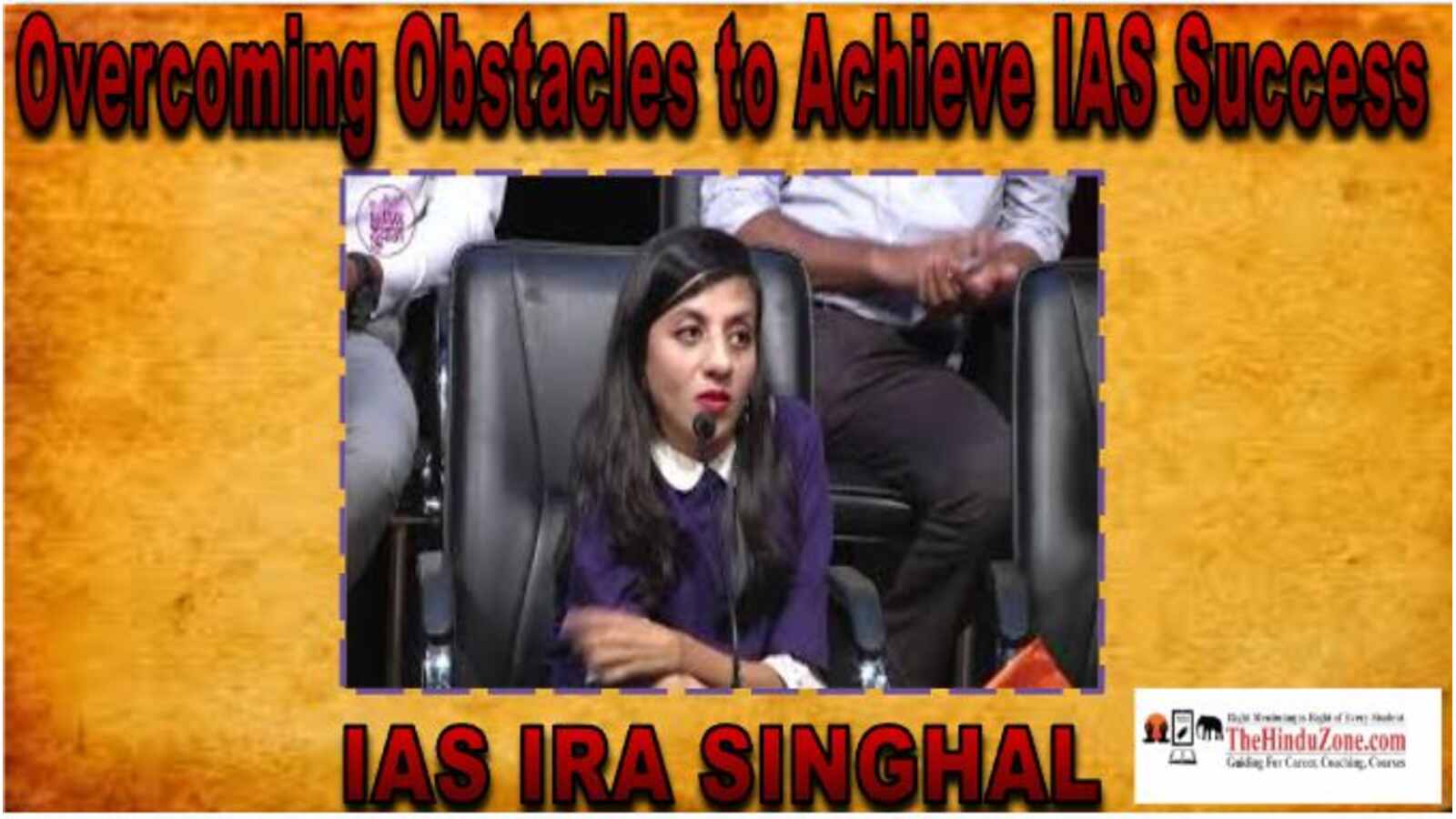
Success stories of UPSC toppers are often filled with hard work, dedication, and perseverance. However, some stories stand out due to the extraordinary struggles and challenges faced by the aspirants. In this article by The Hinduzone, we will discuss Ira Singhal, who overcame Obstacles to Achieve IAS Success. One such story is that of Ira Singhal, a remarkable IAS officer who overcame severe physical disabilities, societal obstacles, and personal challenges to become the first physically challenged woman to secure the first rank in the UPSC Civil Services Examination. This article aims to explore Ira Singhal’s incredible journey, the hurdles she overcame, and her strategies for success.
Background of Ira Singhal
Ira Singhal hails from Meerut, Uttar Pradesh. Her childhood was marked by scoliosis, a condition that causes an abnormal curvature of the spine, which led to her being physically challenged from a very young age. Despite facing this severe disability, Ira had dreams and ambitions far beyond what many would have considered achievable for someone in her condition. She was determined to prove that disability could not define her abilities or limit her aspirations.
Education and Early Career
Ira Singhal completed her schooling and later pursued B.Tech from Netaji Subhash Institute of Technology in Delhi. Following this, she went on to earn an MBA from the Faculty of Management Studies at Delhi University. Her academic journey was already marked by excellence, and she later worked with some of the country’s top companies, including Cadbury India and Coca-Cola. Her professional success in these renowned corporations indicated Ira’s potential and intellect. However, Ira had a larger goal in mind, she wanted to serve the nation through the prestigious Indian Administrative Services.
The Struggles and Obstacles
Ira’s dream of becoming an IAS officer was not an easy one. The UPSC Civil Services Examination is considered one of the most difficult exams in India, and Ira faced not only the challenges that every UPSC aspirant does but also the added challenge of being physically challenged.
The Physical Challenge:
Ira’s condition, scoliosis, made it physically painful for her to sit for long periods. However, this did not deter her from pursuing her dream. She knew that the road ahead was going to be tough, but her determination kept her focused. Despite her physical limitations, Ira faced the examination with confidence, proving that disability cannot be an obstacle to achieving success.
The Societal Challenge:
Ira also had to fight against societal perceptions. In a country like India, where there is often stigma attached to disabilities, being a physically challenged woman pursuing a high-profile job like the IAS was not an easy path. Many people doubted her ability to clear the exams or make it into the prestigious services. But Ira remained unfazed by these external pressures, using them instead as fuel for her ambition.
The UPSC Journey:
Ira’s journey to becoming an IAS officer was not a short or simple one. She attempted the UPSC exam four times. She made her first attempt in 2010, followed by attempts in 2011 and 2013. Although she cleared the exams in all these attempts, her disability posed a barrier to her selection as she was denied a post due to her physical condition.
Undeterred by these setbacks, Ira challenged the decision in the Central Administrative Tribunal, demanding that her eligibility be reconsidered. After a lengthy legal battle, she won the case in 2014, and the court ruled in her favour. The court’s decision was historic as Ira became the first physically challenged woman to be selected in the general category of UPSC and secured the first rank in the Civil Services Examination that year.
Ira Singhal’s Success in UPSC
In 2014, Ira Singhal appeared for the UPSC Civil Services Examination for the fourth time. This time, her perseverance and hard work paid off. She not only cleared the exam but also secured the All India Rank 1, becoming the first physically challenged woman to achieve the top rank in the history of the UPSC exam. Ira’s success was a moment of pride, not just for her but for everyone who believed in breaking barriers. Her triumph over both physical and societal challenges set a shining example for future generations, showing that no barrier is insurmountable if one is determined enough to succeed.
IAS Ira’s UPSC Preparation Tips
Ira Singhal’s journey to success was not just about determination but also about strategizing and following a structured approach to her preparation. Below are some of the key insights and tips that she shared for UPSC aspirants:
1. Focus on Your Strengths
Ira emphasized the importance of focusing on the subjects and topics that you are most confident about. She suggests that aspirants should solve the questions they are sure about first. This approach saves time, reduces pressure, and helps build confidence during the exam.
2. Use Headings and Sub-Headings
In her preparation, Ira found that the effective organization of answers was crucial. By using headings and sub-headings, aspirants can structure their answers clearly, making it easier for examiners to follow. This technique also ensures that important points are highlighted, and the answer remains concise and well-organized.
3. Keep the Language Simple
Ira advises that the language used in the exam should be simple and straightforward. Rather than using complex vocabulary, the key is to convey your ideas clearly and directly. A simple and effective writing style can go a long way in leaving a positive impression on the examiner.
4. Build a Strong Foundation with NCERT
For her preparation, Ira heavily relied on NCERT books, especially for building her basic understanding of subjects. She recommends that aspirants strengthen their foundation by going through NCERT books, particularly for subjects like Geography, History, and Polity. A strong foundation is essential for grasping more complex concepts later on.
5. Stay Updated with Current Affairs
Ira highlights the importance of keeping track of current affairs throughout the preparation period. She stresses that aspirants should have keen eyesight for national and international events, as they form a significant part of the General Studies paper. Regular reading of newspapers, magazines, and journals is essential to stay informed.
6. Never Give Up
Ira’s success story is an embodiment of resilience and perseverance. Despite facing multiple setbacks, she never gave up. Her journey teaches aspirants the importance of self-trust and the ability to rise after every fall. Believe in your capabilities and stay focused on your goals.
Conclusion
Ira Singhal’s story is a perfect example of how passion, perseverance, and hard work can overcome even the most challenging circumstances. Her journey is a reminder that disability is not a limitation but a part of one’s unique identity. It’s a testimony to the fact that success doesn’t come easily, but with determination, nothing is impossible. Ira’s success as an IAS officer has inspired many aspiring civil servants, especially those with disabilities, to pursue their dreams without fear. Her achievements prove that no challenge is too big when you are committed to your goals. Her story is not just about academic excellence; it’s about fighting societal biases, battling personal challenges, and most importantly, never losing sight of the bigger picture. Ira Singhal is indeed a beacon of inspiration for all those who dare to dream big and work hard for it, no matter the odds. This story of Ira Singhal’s triumph over adversity serves as a powerful reminder to never give up on our dreams, regardless of the challenges we may face. Through her success, she has shown that with determination, hard work, and self-belief, anything is possible.